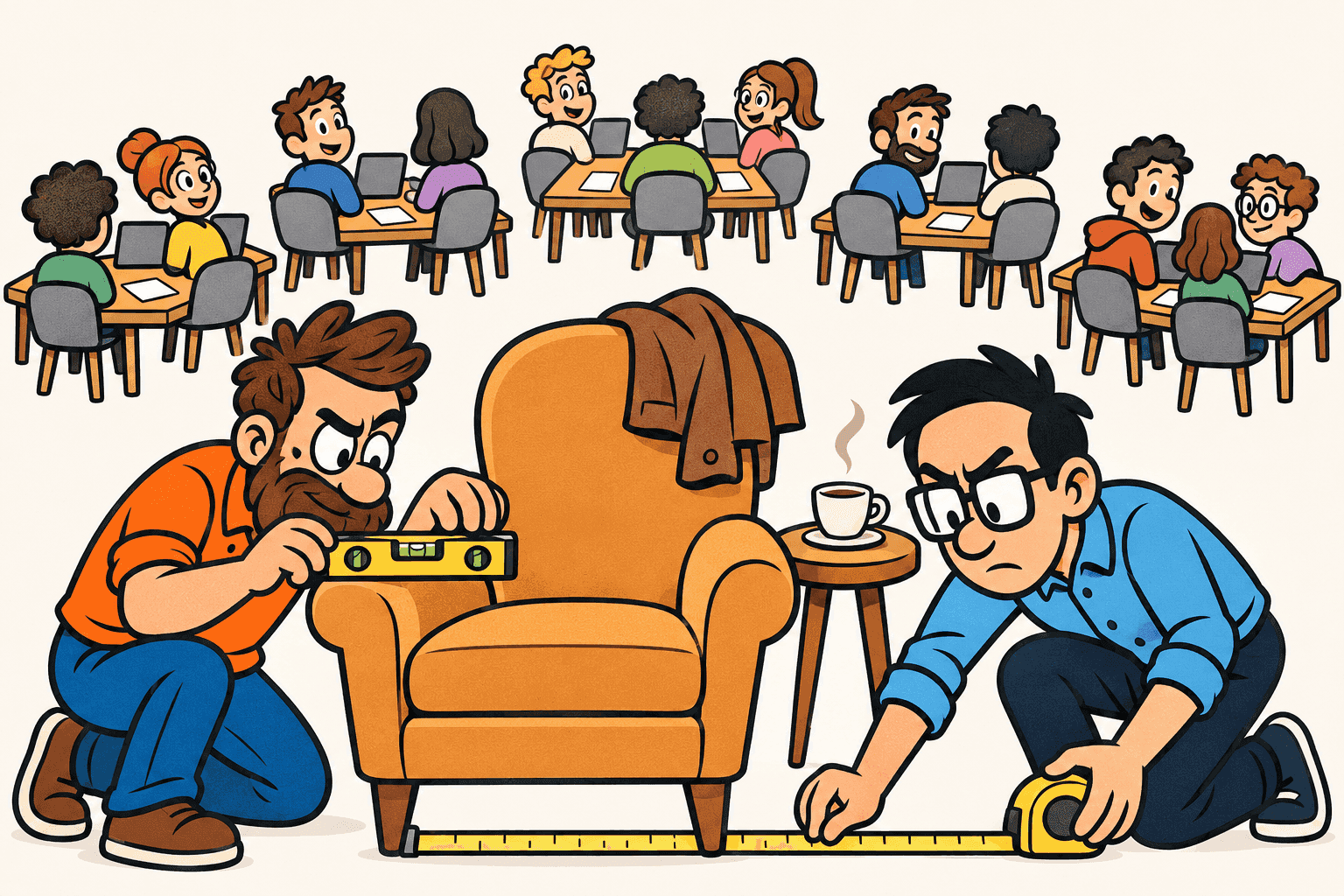
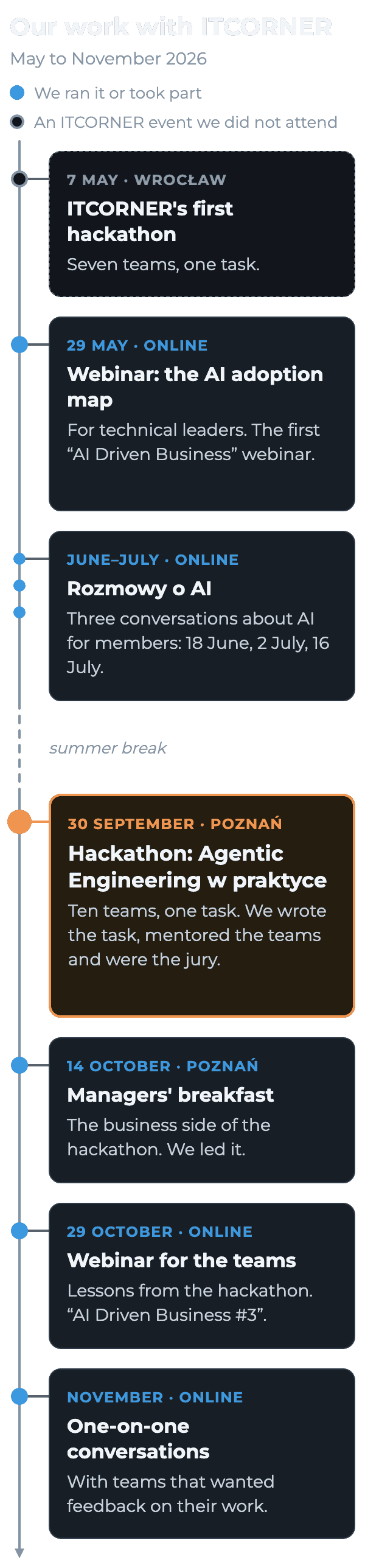
On 30 September 2026, ten teams from nine ITCORNER member companies spent a day in Merixstudio's office in Poznań. They all worked on one task, "Which Vans Go Electric?", for a fictional client who was away all day. It was ITCORNER's second hackathon, "Agentic Engineering w praktyce" (agentic engineering in practice). Two closed meetings followed it: a managers' breakfast on 14 October and a webinar for the teams on 29 October. We, Maciej Laskowski and Tomasz Michalak, wrote the task, mentored the teams, moderated a closed discussion for CTOs and CEOs, and were the jury. Afterwards we led the breakfast and ran the webinar. The hackathon carries most of this post; from the two meetings we share only their topics.
ITCORNER, and how we got to Poznań
ITCORNER is an association. In its own words, translated from Polish, it is "a community of technology company owners". Its formats include managers' breakfasts, the "AI Driven Business" webinars, "Rozmowy o AI" (conversations about AI) and, since May 2026, hackathons on agentic engineering.
The hackathons started in Wrocław on 7 May 2026: seven teams, one task. ITCORNER named a winner there. In the same post, it said the event was not about picking the best team. It was about exchanging experience and comparing approaches.
We started working with ITCORNER a few weeks later. On 29 May we gave the first "AI Driven Business" webinar, on the AI adoption map for technical leaders. In June and July we brought the topics to three "Rozmowy o AI" meetings, moderated by Zbigniew Wantula; the first was about AI governance. After the summer break came Poznań.
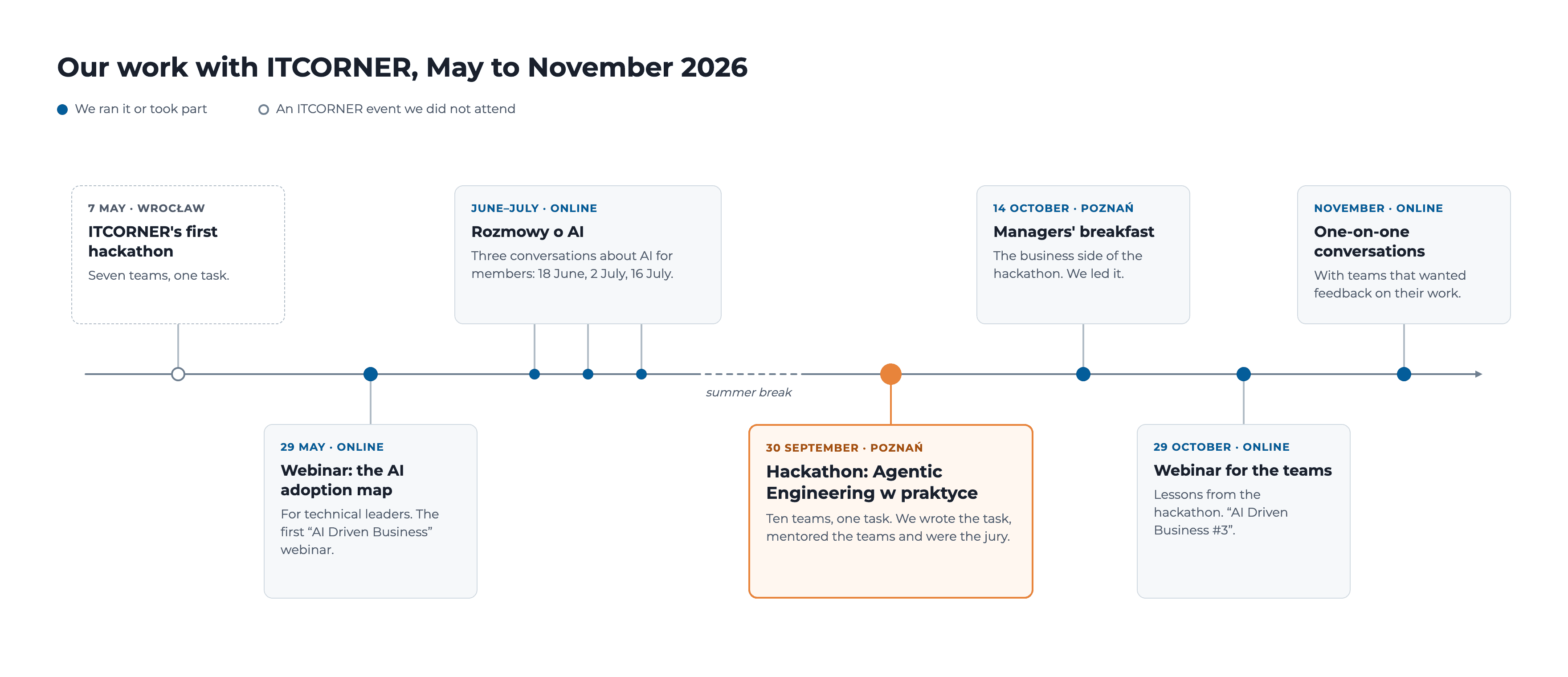
The hackathon, 30 September
The task is fictional and public. Pyrlandia Dostawy supplies bakeries and restaurants across Poznań with 38 diesel vans, and a grant covers up to ten electric ones. Its fleet manager, Ewa, asked for four things:
- a recommendation she could defend at the board: which vans, how many, what it saves;
- something her analyst could rerun next quarter without the team;
- the assumptions the team made while she was away;
- result files in her import format, with a one-page note for the board.
The README put the point plainly: "The focus of today is your process, not the app."
Ewa was away, so each team asked her questions in its own thread on GitHub Discussions. She answered in batches, and every team could read every thread. Her letter set the rule for the rest: "If I can't answer in time, choose, write it down and carry on." At 15:18 she sent a change we had scripted in advance. It brought a fresh data export and a stricter range rule. It also asked each team to say which vans entered or left the shortlist, and why.
Presentations followed. Each started with the process, then a demo was meant to rerun the tool on the latest export. Before presenting, each team was to email both of us its answers to five fixed questions, from its workflow to what it would do differently.
Ten teams got the same brief, the same client and the same change at 15:18. That let us compare their ways of working side by side. We built the task for that:
- With the client away, control meant deciding without her.
- Answers in batches tested how information reached the agents.
- The 15:18 change tested whether that information reached the result.
- The fixed questions made the presentations comparable.
After the presentations, we summarised for the room what we had seen. We also explained the premise we had built the task on: how a team works does not average out, and its weakest part wears down the return on everything else. We had made the longer case in June, in our post on how the weakest part wears down the rest.
What we did
We held four seats at the hackathon. As the task's authors, we chose it in two rounds from several candidates. We wrote Ewa's letter, the data, the teams' texts and the plan of the day, and scripted her change down to the minute. The day before, we ran the whole task as a dry run. On the day, one of us answered as Ewa in every thread.
As mentors, we went round the teams, asked what was blocking them and gave hints. We also moderated a closed, off-the-record discussion for CTOs and CEOs of member companies.
The host announced us as the jury. We judged by ITCORNER's public criteria:
- the level of automation;
- the maturity and repeatability of the process;
- the control and safety mechanisms of the agent's work;
- the quality of the solution, with its code and tests;
- the team's own conclusions.
Beyond the criteria, we weighed three things of our own: each team's questions to Ewa and how consistent they were, what we heard while mentoring, and each team's presentation and solution. After a short deliberation, we named no winner and no ranking, unlike in Wrocław. Every team received a distinction.
The breakfast and the webinar
On 14 October, ITCORNER members met at Kancelaria DSK in Poznań for a closed managers' breakfast. It was for founders, CEOs, CTOs and heads of engineering, under the title, in translation, "ITCORNER hackathon summary: agentic engineering, the business perspective". We led it, with a presentation. Its public announcement asked how a project's effort and cost structure change when agents take over part of the cycle. It also asked which roles and skills gain value, and which need redefining. One thing from the room we made public afterwards (in Polish). The most interesting question was not whether AI would speed up requirements analysis. It was how to build shared knowledge, so that after every change you can quickly see what the change touches.
On 29 October we ran an internal webinar for the teams, "AI Driven Business #3": agentic engineering in practice, with lessons from the ITCORNER hackathon. It has no published recording. We framed it around three questions the hackathon raised (in Polish):
- Who makes the decisions?
- Where does the agent learn the current agreements?
- How do we know the work is done?
Participants brought their own questions. Does writing tests up front add work when a client expects a short budget? And how do you absorb the volume of output agents produce?
In November we talked one-on-one with the teams that wanted feedback on their work.
What we read in the teams' work
We read the hackathon through the breakfast's questions: what does the teams' work mean for a company that builds software for clients like Ewa? Our reading rests on our seats as the task's authors and its jury, and on every team's material. It is not a measured result. Most of what we know about how teams worked is their own account.
From writing code to judging it
Every team told us agents wrote all or almost all of its code. People spent their time reviewing agent output, deciding, and writing the inputs agents work from. For most teams, reviewing and deciding took most of their time. Some told us review became the bottleneck, or was not independent enough.
That is our answer to the breakfast's question about cost: the expensive hour moved from writing code to judging it. A company that plans, staffs and prices by coding effort is planning for the work that just got cheap. What limits delivery now is how many people can review and decide well.
Deciding without the client
In the morning threads, several teams attached their own default to every question, so work never had to wait for Ewa. Judging by what they showed or told us:
- most kept a written record of assumptions or decisions;
- most held her rules as named settings;
- several used answers she had given in other teams' threads.
Working on stated defaults while she answered in batches was among the frictions teams named most often.
No client is available on the team's schedule; Ewa only made it explicit. A team that moves on a stated default does not spend paid hours waiting. A written assumption pays off later too: when the client says "that is not what I meant", both sides start from a record they can review, not from a dispute about scope. A rule held as a setting makes a changed rule a changed value. That is cheaper to deliver and easier to price than changed code.
Specify first, next time
The most common plan for next time was to pin things down before any code: the specification, the shape of the outputs, the expected results or the tests. That is the teams' conclusion. What it means for a client is our reading. When agents write the code, the specification is where the product is really decided. A vague one is rework produced at agent speed and reviewed at human speed.
If you run a software house or a product company and want to know where your teams stand with AI coding agents, start with a 30-minute conversation: tell us what you are trying to decide, and we will say plainly whether we can help. See how we start.
What comes next
Thank you to:
- ITCORNER;
- Zbigniew Wantula, our first contact there, who brought us in;
- Karolina Charewicz-Jakubowska, for the invitation and the cooperation;
- Jarosław Zieliński (Welastic), host and coordinator of the Poznań hackathon;
- Monika Bogacz (ITCORNER), for the organisation;
- Marcin Staszak and Merixstudio, for hosting the hackathon;
- Kancelaria DSK, for hosting the breakfast;
- the ten teams.
The next hackathons are on the way, and "Rozmowy o AI" continues. Neither has a date yet, so watch ITCORNER's events page. If your company is an ITCORNER member, field a team or take an observer's seat at the next hackathon, and join "Rozmowy o AI". If it is not, the task is public: Ewa's letter, the data, her change and the presentation guide. Try it with your own team, and keep Ewa away all day.